
Sharklife BRUV monitoring · iSimangaliso Marine Protected Area
What hundreds of underwater cameras revealed about sharks and rays off iSimangaliso
Years of baited remote underwater video surveys are building a picture of a coastline used by sharks, rays and wedgefish in very different ways — across seasons, depths and habitats.
Drop a baited camera on the seabed for an hour and you may see nothing. Or a shark may appear within seconds. Repeat that process hundreds of times, across different depths and habitats, and individual encounters begin to form a much bigger ecological story.
Between October 2020 and March 2023, Sharklife completed 779 stereo-BRUV deployments across the iSimangaliso Marine Protected Area. Sharks or rays were recorded on 64% of those deployments, with 27 elasmobranch taxa detected by the cameras.

Important: these are BRUV research records, not recreational scuba-diving sightings. The cameras sampled a wider range of depths, habitats and locations than normal dive activity.
This is not only a shark story
The BRUV dataset recorded a cumulative MaxN of 1,187 elasmobranchs. The split was almost perfectly even: 585 sharks and 602 rays.

That near-even split changes how we should think about the local elasmobranch community.
The unexpected shark that dominated the cameras
If you asked most visitors to name the shark most likely to dominate a long-term Sodwana dataset, whitetip or grey reef sharks might come to mind. The BRUV cameras told a different story.
Human’s whaler sharks accounted for 260 BRUV records and approximately 49.1% of all shark sightings in the baseline analysis. They were also the most recorded species across every season and every area where seasonal comparisons were possible.

Among sharks, tiger sharks were the next major contributor, followed by grey reef sharks. But the small and comparatively unfamiliar Human’s whaler was the species the cameras recorded again and again.
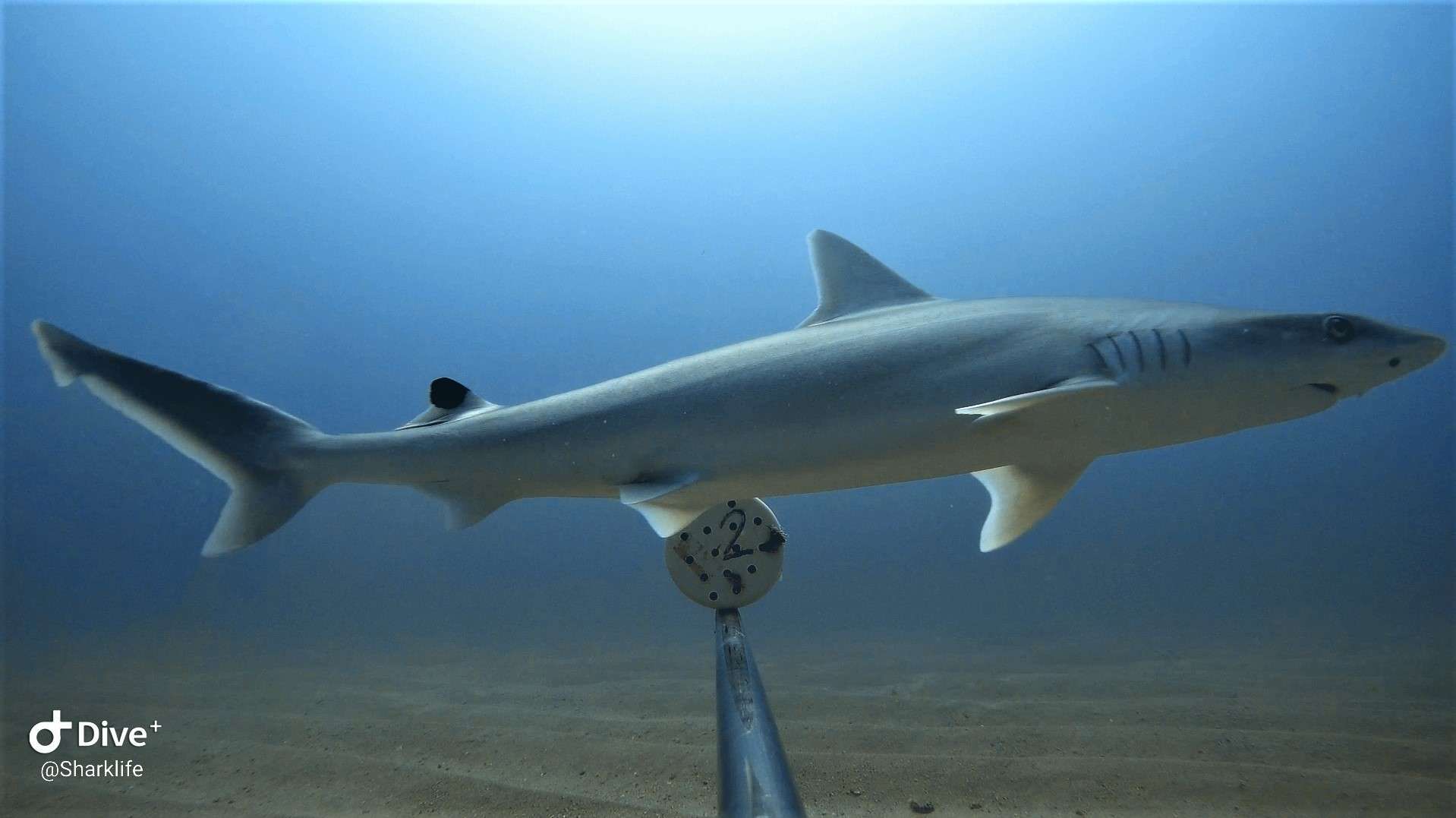
The Humans Whaler , now known as the African blackspot shark (Carcharhinus humani) This small coastal requiem shark was only formally described as a distinct species in 2014 and is restricted to the western Indian Ocean. Along the east coast of South Africa it occurs as far south as Port St Johns. Sharklife contributed BRUV data to a 2024 study led by Geremy Cliff that examined its biology, distribution and ecology in South African waters.
Wedgefish are not a side note
The white-spotted wedgefish was the third most recorded elasmobranch in the BRUV dataset, with 145 records. Within the batoid component of the study, wedgefish represented a substantial share of observations.


Whitespotted wedgefish (Rhynchobatus djiddensis) — despite their shark-like shape, wedgefish are actually rays. They belong to the order Rhinopristiformes, a group of “shark-like rays” that also includes guitarfishes and sawfishes. The whitespotted wedgefish can exceed 3 m in length and is currently listed as Critically Endangered. Around Sodwana Bay it was one of the most frequently recorded elasmobranchs in Sharklife’s BRUV surveys.
Wedgefish or guitarfish?
The names are often confused in South Africa. We explain the difference, and some of the misleading common names, in our earlier Sharklife article: Read Article
One strength of a long-term dataset is that it can flag species worth investigating before a dedicated project is even designed. That historical signal is one reason wedgefish have become an increasingly important focus of Sharklife’s ongoing research into habitat use, movement and vulnerability.
Going deeper changed what the cameras saw
Depth was one of the clearest ecological patterns in the baseline BRUV analysis. The probability of recording an elasmobranch increased from shallow to deeper deployments.
56%
Shallow
~12-15 m
68%
Mid-depth
~18–25 m
71%
Deep
~25 m
The shallow-to-mid and shallow-to-deep differences were statistically significant. Yet overall species diversity remained fairly similar across depth categories. What changed was the character of the assemblage: shark diversity was highest in deeper water, while ray diversity was highest in shallower water.
The habitat beyond the reef
The iSimangaliso seascape is often imagined as a chain of coral reefs. The BRUV data show why the surrounding sand should not be treated as empty space.
Reef-associated patterns
Grey reef and whitetip reef sharks showed the expected strong association with reef habitat.
Sand-associated patterns
Benthic rays showed a strong association with sand, while sliteye sharks and smooth hammerheads were recorded exclusively over sand in the baseline dataset.
Benthic rays were recorded not only on sand immediately beside reef systems, but also on sandy habitat more than 10 km from reef. Protecting the reef alone does not therefore capture the full habitat story.
The canyon may be shaping encounters
A separate arrival-time analysis used 206 BRUV deployments near Diepgat and Wright Canyons. Animals arrived at cameras anywhere from a few seconds after deployment to well beyond the standard one-hour survey period.

The mechanism is not yet fully resolved. Species identity had the strongest influence, while current speed and bottom temperature also had weaker significant effects. The canyon result raises a bigger ecological question: are these underwater features influencing where sharks and rays concentrate or move?
When are sharks and rays recorded?
Seasonal patterns are real, but they do not play out in exactly the same way everywhere. Some areas showed clear seasonal differences, while others did not. Near Mabibi, ray observations doubled in summer even though shark observations remained similar between seasons.
The calendar below therefore shows when species were recorded by BRUV surveys. It should not be read as a diving-sightings guide or as proof that an animal is absent during months with no camera detection.

Rare encounters show the value of long-term monitoring
Some species appeared only once or twice across hundreds of BRUV deployments. A much shorter study could easily have missed them completely.

Even after 779 BRUV surveys, the cumulative species curve had not reached a clear plateau. In simple terms: there were probably still species left to record.

Bowmouth guitarfish (Rhina ancylostoma) — despite the name, this extraordinary animal is a ray and belongs to the wedgefish family. Its broad rounded head, heavy thorn-like ridges and shark-like tail make it one of the most distinctive elasmobranchs in the Indo-West Pacific. It can reach around 3 m in length, yet remains poorly known and is rarely encountered in surveys.
Different survey methods reveal different animals
BRUVs are only one part of Sharklife’s monitoring programme. Underwater visual census surveys recorded species the baited cameras did not, while BRUVs recorded species that divers did not encounter during the survey programme.
Why use more than one method? Animals respond differently to divers, bait and habitat. Combining methods gives a broader picture than any single survey technique can provide.
This is one reason the BRUV calendar should never be interpreted as a complete list of when a species occurs in the area. It describes the camera record, not the entire marine community.
The story is still growing
The original 2020–2023 baseline was not the end of the programme. The 2023–2024 continuation added 141 verified stereo-BRUV deployments, taking the documented programme total to 920 deployments by that stage.
- 2020–2023 · Baseline assessment: 779 BRUV deployments established the first multi-year reference dataset.
- 2023–2024 · Continuation: a further 141 verified deployments extended seasonal and spatial coverage.
- Ongoing · New questions: continued BRUV monitoring is now supporting more focused work on sharks, wedgefish and habitat use.
Long-term monitoring does not lead to one final answer. Its real strength is the baseline it creates: patterns become clearer, gaps become visible, and each new survey helps sharpen the next question.
Data note: baseline findings are drawn from Sharklife’s 2020–2023 iSimangaliso Elasmobranch Assessment. The 2023–2024 continuation used the same stereo-BRUV approach but did not have identical spatial and seasonal coverage, so it should not be treated as a uniformly sampled extension of the baseline time series. BRUV values represent survey records and relative-abundance metrics, not estimates of total population size.